


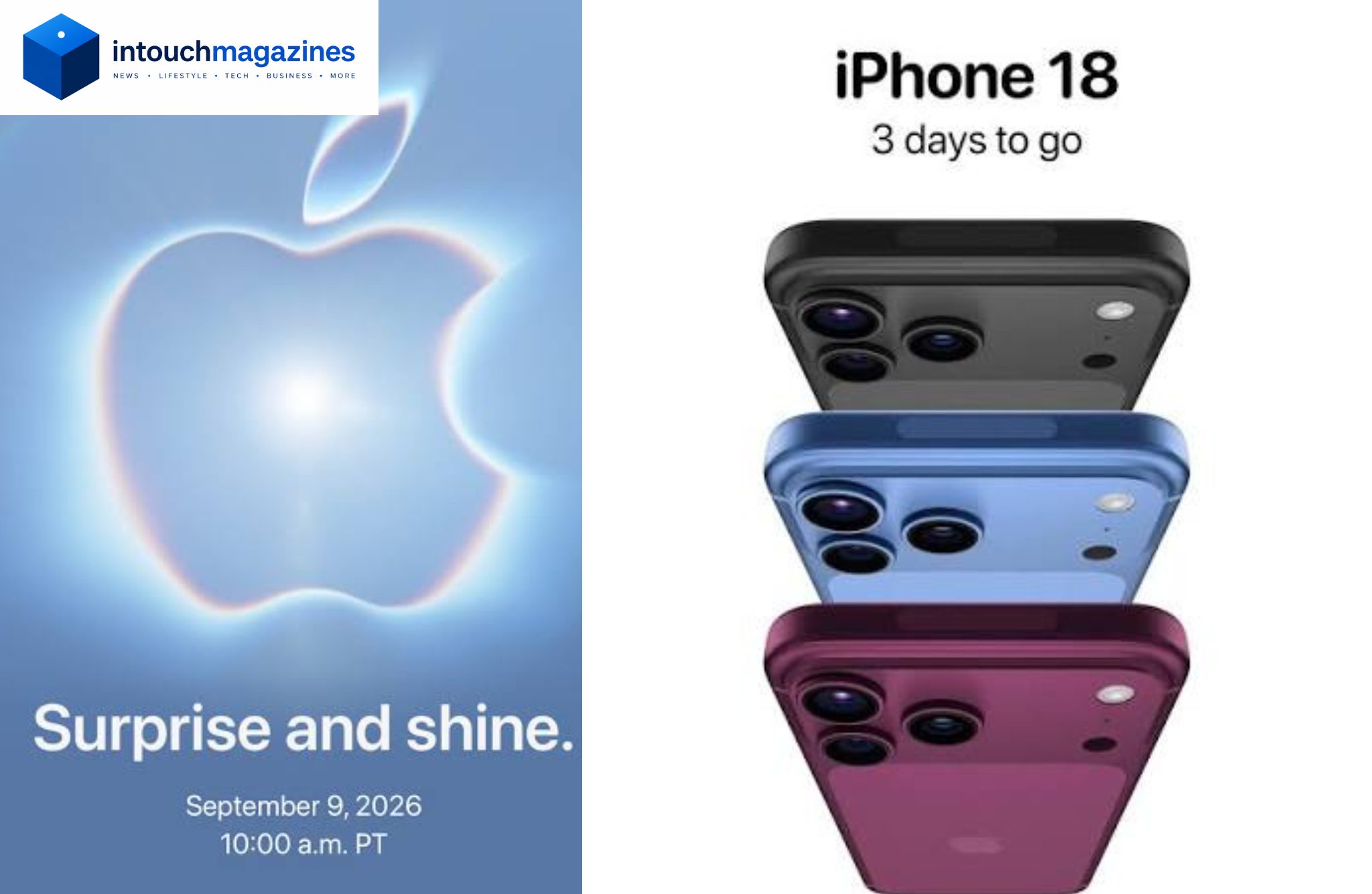
Apple’s most anticipated product event in nearly a decade took place on September 9, 2026, and it lived up to the hype. Dubbed “Surprise and Shine,” the annual iPhone keynote brought Apple’s first-ever foldable smartphone. It also delivered the next generation of Pro-tier flagship devices, new smart wearable models, and refreshed software platforms. On top of that, it marked a landmark moment: the debut of new CEO John Ternus on the world stage. This article covers every announcement, every spec, and what it all means for consumers worldwide.
What Is Apple’s “Surprise and Shine” Event?
Apple held its “Surprise and Shine” event on Wednesday, September 9, 2026, at 10 a.m. PDT / 1 p.m. EDT at the Steve Jobs Theater on the Apple Park campus in Cupertino, California. The company livestreamed the product launch globally on Apple’s website, through the Apple TV app, and on YouTube. As a result, the keynote reached millions of tech enthusiasts and industry analysts in real time.
Apple etched the tagline onto every media invitation alongside a glowing Apple logo with a sun shining through. It was, characteristically, a cryptic hint. In retrospect, “Surprise” pointed squarely at the company’s first-ever foldable iPhone, a device years in development. Meanwhile, “Shine” reflected the event’s emphasis on display breakthroughs, camera technology, and a new era of leadership.
Three key reasons set this event apart from any recent Apple keynote. First, it marked the debut of an entirely new iPhone form factor, the first since the iPhone X in 2017. Second, Apple introduced a split iPhone launch strategy, pushing standard models to Spring 2027. Third, new CEO John Ternus took the stage, having officially succeeded Tim Cook on September 1, 2026.
John Ternus Takes the Stage: Apple’s New Era Begins
Who Is John Ternus?
Indeed, John Ternus is no newcomer to Apple events. For years, he presented hardware segments at keynotes as the company’s Senior Vice President of Hardware Engineering. However, stepping onto the Steve Jobs Theater stage as CEO marked a defining moment. It mattered both for Ternus personally and for Apple as a company.
Ternus officially took the role of CEO on September 1, 2026, succeeding Tim Cook, who transitioned to Executive Chairman. Apple announced the leadership change back in April 2026. Consequently, markets and Apple’s global user base had time to absorb the transition. Cook’s tenure, which began in 2011, centered on operational excellence, supply chain mastery, and revenue records. Ternus, by contrast, brings a deeply product-centric and engineering-first perspective. Notably, he oversaw the Apple Silicon transition and the iPhone 14’s titanium redesign. He also led development of the very foldable phone he announced at this event.
What Ternus’s Leadership Signals for Apple’s Future
A hardware engineer leading Apple signals a clear shift toward bolder product bets. Tim Cook’s Apple operated with extraordinary discipline: iterative, cautious, and margin-focused. Ternus’s Apple, based on this first event, appears willing to take bigger swings. Specifically, the company launched a new form factor at a $1,999+ price point. It also broke a decade-long launch tradition with a split calendar. Additionally, it introduced foldable display technology it confidently describes as “virtually crease-free.”
Furthermore, industry analysts point out that Ternus’s background positions Apple to accelerate hardware innovation. This applies especially to augmented reality, health technology, and foldables. These are areas where Apple has historically moved deliberately, yet the competitive landscape is shifting fast.
The Star of the Show: iPhone Ultra, Apple’s First Foldable iPhone
Above all, no product at the “Surprise and Shine” event attracted more anticipation than this one. Apple’s first foldable smartphone, widely called the iPhone Ultra, represents the most significant iPhone design departure since 2017. That year, the original iPhone X introduced Face ID and the edge-to-edge display.
Design and Form Factor
The iPhone Ultra adopts a book-style folding design, the same form factor Samsung popularized with the Galaxy Z Fold series. In its closed state, users interact with an outer cover OLED display measuring 5.3 to 5.5 inches. That’s a perfectly functional smartphone screen on its own. When open, the device reveals a 7.6 to 7.8-inch inner display with a 4:3 aspect ratio. This roughly matches the footprint of an iPad mini. In essence, it functions as a mobile device that transforms into a compact tablet, blurring the line between handset and tablet computing.
Apple’s construction choices reflect its premium-first philosophy. The frame uses titanium, the same material Apple introduced on the iPhone 15 Pro. Moreover, engineers built the device to be ultra-thin. This directly addresses one of the most common criticisms of competing foldables: excessive bulk when closed.
Most consequentially, Apple claims the iPhone Ultra features a virtually crease-free inner display. The crease is the visible fold line that bisects screens on Samsung, Google, and Huawei foldables. It has long been the category’s most persistent and irritating flaw. Apple reportedly spent years engineering the hinge and display layers to eliminate it. Still, whether this claim holds up under real-world use remains an open question. Reviewers will answer it in the weeks ahead.
Additionally, color options at launch include black and silver finishes, consistent with Apple’s Pro-tier aesthetic.
Specs and Performance
Under the hood, Apple powers the iPhone Ultra with its A20 Pro chipset, built on a cutting-edge 2nm process. Consequently, the move to 2nm brings measurable gains in CPU performance, GPU rendering, and power efficiency. As a result, the device sustains intensive tasks across its larger displays without proportional battery drain.
One notable departure from recent flagship iPhone design stands out. The iPhone Ultra replaces Face ID with Touch ID integrated into the power button for biometric authentication. This practical concession suits the foldable form factor. After all, a folded phone’s outer display geometry complicates reliable facial recognition placement. It also marks the first time Apple has shipped fingerprint sensing as the primary security method on a flagship iPhone in years.
The camera system features two front-facing cameras (one for each display position) and a dual rear camera system. Apple splits the battery configuration between the two halves of the device. As a result, total estimated capacity reaches 5,400 to 5,800 mAh. For comparison, the iPhone 17 Pro Max carries a 5,088 mAh battery.
Price, Availability, and Pre-Order Dates
Overall, the iPhone Ultra stands as Apple’s most expensive iPhone ever. Apple estimates the starting price at $1,999, with higher-tier configurations potentially reaching $2,500. These figures reflect both the premium materials and Apple’s decision to position the Ultra as a new tier above the Pro Max.
Pre-orders open on Friday, September 11 (or Saturday, September 12, to avoid the 9/11 anniversary). Devices then ship to customers on Friday, September 19, 2026.
So, who should buy it at launch? Early adopters who want Apple’s most innovative hardware will find it compelling, especially those who accept that first-generation foldable technology will improve over iterations. On the other hand, those on tighter budgets should consider the iPhone 18 Pro instead. Alternatively, they could wait for the Spring 2027 standard lineup.
iPhone 18 Pro and iPhone 18 Pro Max: What’s New
While the iPhone Ultra dominates headlines, the iPhone 18 Pro and iPhone 18 Pro Max still deliver a meaningful upgrade. It’s a more evolutionary one for most of Apple’s premium customer base.
Camera Upgrades
The standout camera feature this year is the variable aperture rear camera. This is the ability to physically change the size of the lens opening to control depth of field and light intake. In practice, photographers gain more artistic control and significantly better low-light performance. However, in a notable last-minute revelation, the variable aperture feature turned out to be exclusive to the iPhone 18 Pro Max. Leaker Ice Universe confirmed the detail, and Bloomberg’s Mark Gurman corroborated it. Notably, the smaller iPhone 18 Pro does not include it.
Also, both Pro models benefit from a smaller Dynamic Island, continuing Apple’s gradual reduction of the front-facing sensor cluster. Additionally, display technology sees refinements, though overall panel sizes carry over from the iPhone 17 Pro generation.
Chip, Connectivity, and Display
Like the iPhone Ultra, both Pro models run on the A20 Pro chipset at 2nm. They also introduce Apple’s C2 cellular modem, the second generation of Apple’s in-house modem design. As a result, users gain improved 5G connectivity speeds and faster wireless data transfer. Additionally, power management becomes more efficient compared to the Qualcomm modem it replaced.
What’s NOT Here: The Missing iPhone 18
In a significant break from a decade-long tradition, Apple did not announce a standard iPhone 18 at this event. Instead, Apple confirmed the base iPhone 18, iPhone 18e, and iPhone Air 2 will launch in Spring 2027. This deliberate decision splits the product lineup. Consequently, it also reduces the supply chain complexity of launching four or more iPhone models simultaneously in September.
For budget-conscious buyers who typically wait for the standard model, this means a longer wait ahead. Their key decision comes down to three options: purchase an older iPhone 17 now, wait for the Spring 2027 launch, or stretch the budget toward the Pro tier.
Apple Watch Series 12 and Apple Watch Ultra 4
Apple Watch Series 12
The Apple Watch Series 12 arrives as an iterative but meaningful update to Apple’s flagship wearable technology. New health sensors continue Apple’s push into blood pressure monitoring, heart rate tracking, and advanced sleep tracking. Furthermore, the smartwatch ships with watchOS 27, which introduces deeper integration with iOS 27’s AI assistant features. For instance, Siri AI can now manage calendar events and messages directly from the wrist.
Pricing and availability follow the same schedule as the iPhones. Specifically, pre-orders open September 11, and devices ship on September 19.
Apple Watch Ultra 4
Likewise, the Apple Watch Ultra 4 targets athletes, adventurers, and outdoor professionals. It brings further refinements to durability, battery life, and ruggedness. For the outdoor and fitness community, the Ultra remains Apple’s most capable wearable. Additionally, the fourth generation continues the trajectory Apple set with the original Ultra’s 2022 debut. That launch repositioned the company as a serious player in the premium sports watch market alongside Garmin.
iOS 27, watchOS 27, and the Full Software Lineup
iOS 27: Release Date and Key Features
To begin with, Apple confirmed iOS 27’s public release for the week of September 19, 2026, aligned with the hardware shipping schedule. The software update’s most visible change is the Liquid Glass interface, a redesigned, more transparent user interface. In fact, Apple describes it as its most significant foundational visual refresh since iOS 7 flattened the skeuomorphic design language in 2013.
Beyond the visual refresh, the most important functional addition is Siri AI. This is a comprehensively rebuilt voice assistant and virtual assistant using modern large language model technology. Unlike the previous generation, Siri AI interacts meaningfully with apps across the operating system. Specifically, it composes and sends messages, creates and edits calendar events, and pulls information from emails. It also executes multi-step tasks with contextual understanding and natural language processing.
Moreover, Apple’s approach to artificial intelligence stays privacy-first. On-device processing and local data handling remain the priority wherever possible. This architectural choice clearly distinguishes Apple from Google’s and Samsung’s more cloud-dependent AI implementations.
Regarding compatibility, iOS 27 supports iPhone 13 and later. That said, Apple has not officially confirmed the full device list at time of writing.
watchOS 27, macOS Golden Gate, and More
watchOS 27 ships alongside the Apple Watch Series 12 on September 19. Similarly, macOS 27 Golden Gate arrives around September 22, 2026, together with the new Mac mini and Mac Studio featuring the M6 chip. In addition, iPadOS 27, tvOS 27, and visionOS 27 roll out on a similar schedule. Together, these updates complete Apple’s annual OS refresh across every platform.
Other Announcements: AirPods, HomePad, and Smart Home
New AirPods
Meanwhile, Apple also unveiled a new AirPods lineup at the “Surprise and Shine” event. The standout improvement is enhanced active noise cancellation on the AirPods Pro 3. This third generation of Apple’s premium earbuds refines audio performance and updates the chip. In turn, that enables tighter integration with iOS 27’s spatial audio and Siri AI features.
HomePad, Apple TV 4K, and HomePod mini
Elsewhere, Apple invested fresh resources into its smart home ambitions at this event. The long-rumored home hub, a central smart home controller and home automation device, is years in development. It is expected to debut or be previewed alongside an updated HomePod mini and a new Apple TV 4K streaming device. Apple’s goal is straightforward: compete more aggressively with Google Nest and Amazon Echo. Specifically, it aims to do so by building a cohesive, privacy-forward connected home ecosystem powered by Apple silicon.
Pre-Order and Release Dates: Complete Timeline
Below is the full launch schedule for every product Apple announced at the “Surprise and Shine” event:
| Product | Pre-Order Date | Release / Ship Date |
|---|---|---|
| iPhone Ultra (foldable) | September 11, 2026 | September 19, 2026 |
| iPhone 18 Pro | September 11, 2026 | September 19, 2026 |
| iPhone 18 Pro Max | September 11, 2026 | September 19, 2026 |
| Apple Watch Series 12 | September 11, 2026 | September 19, 2026 |
| Apple Watch Ultra 4 | September 11, 2026 | September 19, 2026 |
| iOS 27 / watchOS 27 | N/A | Week of September 19, 2026 |
| Mac mini (M6) / Mac Studio | N/A | September 22, 2026 |
| macOS 27 Golden Gate | N/A | Around September 22, 2026 |
| iPhone 18 / iPhone Air 2 / iPhone 18e | TBA | Spring 2027 |
How to watch the event replay: The full keynote is available on Apple’s website (apple.com/apple-events), the Apple TV app, and Apple’s official YouTube channel.
What the “Surprise and Shine” Event Means for the Industry
The Foldable iPhone’s Broader Impact
Apple’s entry into the foldable smartphone market is not just a product launch. Rather, it is a market-validation moment, since Apple tends to define a category once it enters. For years, in comparison, Samsung led the foldable segment with the Galaxy Z Fold and Z Flip lines, while Google entered with the Pixel Fold. Nevertheless, mass adoption remained elusive. That’s partly because the form factor carried compromises such as visible creases, bulk, fragility, and high prices that deterred mainstream buyers.
Importantly, Apple’s crease-free claim, if it holds, removes the most visible barrier to foldable adoption. Combined with Apple’s ecosystem advantages, iOS 27, and the iPhone Ultra’s titanium build quality, this event could move foldables from enthusiast curiosity toward mainstream aspiration.
Apple’s Split-Launch Strategy: What It Means for You
Notably, delaying the standard iPhone 18 to Spring 2027 represents a meaningful strategic shift. For Apple, the move simplifies the September supply chain and creates a sharper focus on the premium tier. For consumers, meanwhile, it creates a clearer decision point: commit to the Pro tier now, or wait six months for the more accessible models.
Furthermore, the split launch suggests Apple may be moving toward a semi-annual release cadence. This model is closer to how some Android manufacturers already operate. Ultimately, this approach could allow Apple to address different market segments at more appropriate price points throughout the year.
Siri AI and Apple’s Artificial Intelligence Strategy
The launch of Siri AI represents Apple’s most significant AI product statement since Apple Intelligence debuted in 2024. By rebuilding Siri on large language model foundations, Apple directly enters the conversational AI space. Google Gemini and Samsung Galaxy AI have both aggressively invested in this space already.
Apple’s differentiator remains clear: on-device processing, no training on user data, and a framework that puts users in control. However, whether that approach can match the capability of cloud-first AI competitors remains the central tension in Apple’s AI story. iOS 27 will be the proving ground.
Frequently Asked Questions
Apple held the event on Wednesday, September 9, 2026, at 10 a.m. PDT / 1 p.m. EDT / 6 p.m. BST / 10:30 p.m. IST at the Steve Jobs Theater, Apple Park, Cupertino, California.
Apple announced the iPhone Ultra (first foldable iPhone), iPhone 18 Pro, iPhone 18 Pro Max, Apple Watch Series 12, Apple Watch Ultra 4, new AirPods Pro 3, iOS 27 with Siri AI and Liquid Glass interface, and smart home devices including a new HomePad.
The iPhone Ultra is Apple’s first foldable smartphone. It features a book-style design with a 5.3 to 5.5-inch outer display and a 7.6 to 7.8-inch inner display, runs on the A20 Pro chip, and starts at an estimated $1,999.
No. Apple delayed the standard iPhone 18, iPhone 18e, and iPhone Air 2 to Spring 2027. Only the iPhone 18 Pro, iPhone 18 Pro Max, and iPhone Ultra launched in September 2026.
Apple plans to release iOS 27 publicly during the week of September 19, 2026, the same week the new hardware ships to customers.
John Ternus, Apple’s former Senior Vice President of Hardware Engineering, became CEO on September 1, 2026. He succeeded Tim Cook, who moved to the role of Executive Chairman.
The iPhone Ultra starts at approximately $1,999, with higher-tier configurations potentially reaching $2,500, making it Apple’s most expensive iPhone to date.
The full keynote replay is available on Apple’s official website at apple.com/apple-events, through the Apple TV app on any Apple device, and on Apple’s official YouTube channel.


2 Comments
Pingback: iPhone Duo: Everything You Need to Know
Pingback: How to Change Home Address on Google Maps